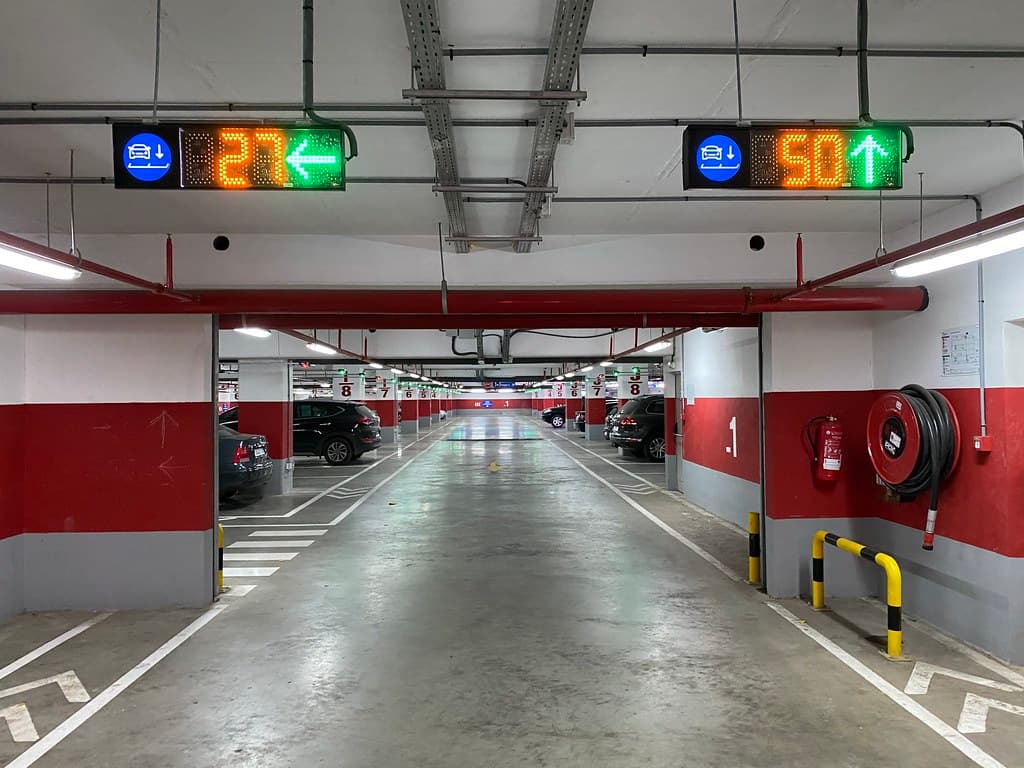
Level 1 of an underground parking garage in Casablanca, photographed down the central driving lane in the early afternoon. The frame is built around two pieces of signage hanging from a transverse red beam: on the left, an LED counter showing “27” in orange next to a left-pointing arrow - 27 free spaces in that aisle - and on the right, “50” in green with an upward arrow indicating fifty more bays available straight ahead. The colour coding is the give-away: orange for “getting full”, green for “plenty of room”.
Architecturally the space is doing the standard things you’d expect from a modern garage. The structural columns are painted in horizontal red-and-white bands, an old visibility convention so drivers can judge clearance and speed in low light. A continuous painted band along the side walls (red below, light grey above) reinforces the same idea at vehicle-bumper height. Above the beam, the ceiling carries the building’s mechanical services on display: a thick pipe run, electrical conduit and metal cable trays, all left exposed because there is no reason to hide them. On the right-hand wall, slightly hard to spot at first, a coiled red fire hose reel is mounted next to a small notice; closer to the camera, a pair of yellow-and-black safety bollards protect the corner of a column. A large painted “1” on the wall confirms the parking level.
I had just parked and turned around before walking to the lift when I noticed how clean the perspective was - the lane completely empty in front of me, the two LED signs lining up almost exactly with the receding columns. The composition is doing two things at once: the converging lines of the columns and the floor markings pull the eye to a vanishing point at the back wall, and the live occupancy counters give the photo a small piece of state, a snapshot of the building at one specific moment (27 left, 50 ahead). I like utilitarian architecture for exactly that reason. It’s designed entirely around function, and the visual rhythm - the repetition of columns, signage, lights, painted bands - is a side effect of solving the problem well.